Investing in estate is a good way to build wealth over time.. Buying a property just because it is in a good location or seems to have good rental income is not enough. Every successful real estate investor knows that they need to do financial analysis before making a decision. Things like location, infrastructure and market demand affect how much a property is worth. Investors should always use reliable financial metrics to make their decisions. There are tools that investors use but Capitalization Rate, Internal Rate of Return and Cash-on-Cash Return are the three most important ones. These metrics help investors figure out how income they can get from a property how profitable it will be in the long run and how well their invested money is working. Whether you are buying your house investing in commercial real estate or building a diverse portfolio understanding these concepts will help you make smarter decisions.
Many new investors make the mistake of only comparing properties based on their price or how much they might appreciate.. Two properties with the same price can have very different financial outcomes.
For example imagine two investors, Investor A and Investor B. Investor A buys an office for ₹1 crore that makes ₹8 lakh in rental income each year. Investor B buys another office for the price but it only makes ₹5 lakh in rental income because it has higher maintenance costs and lower occupancy. Even though they spent the amount their returns are very different.Without doing a financial analysis it is impossible to know which property is a better deal. This is where investment metrics come in. Capitalization Rate measures how well a property makes income Cash-on-Cash Return measures how return an investor gets on their actual investment and Internal Rate of Return measures the total profitability of an investment. Together these metrics give a picture of a property's performance.
Capitalization Rate or Cap Rate is one of the most widely used metrics in real estate investing. It measures the relationship between a properties net operating income and its market value.
In terms Cap Rate tells an investor how much income a property makes each year before considering financing costs. The calculation is based on the following formula: Cap Rate = Net Operating Income ÷ Property Value × 100. For example imagine you buy a property for ₹1 crore. The property makes ₹10 lakh in income each year and operating expenses are ₹3 lakh. The Net Operating Income is ₹7 lakh. Cap Rate = ₹7 lakh ÷ ₹1 crore × 100 = 7%. This means the property makes a 7% return each year before financing costs.
A higher Cap Rate usually means income potential but it can also mean higher investment risk. On the hand a lower Cap Rate is often associated with premium properties in established markets where investors are willing to accept lower returns for more stability
While Cap Rate measures income, Internal Rate of Return or IRR measures the overall profitability of an investment over its entire holding period. IRR considers every cash flow associated with the property, including income, maintenance costs, future appreciation and the final selling price.
For example suppose you buy an office space for ₹1 crore. The property makes income for ten years and is eventually sold for ₹2 crore. After considering the income, annual expenses, appreciation and final sale proceeds the investment may produce an IRR of 15%. This means the investment made an annual return of 15% over the entire holding period.
IRR is particularly useful for evaluating long-term investments where appreciation plays a role. Institutional investors, private equity firms and real estate developers rely heavily on IRR because it gives an assessment of investment performance.
Many real estate investors use loans to finance their purchases. In cases evaluating returns based only on the properties purchase price may not give an accurate picture of the investors actual performance. This is where Cash-on-Cash Return comes in. Cash-on-Cash Return measures the cash income earned on the actual cash invested by the investor after accounting for financing costs. Of focusing on the total property value it evaluates how efficiently the investors own capital is generating returns.
For example imagine you buy a property ₹1 crore. You make a ₹20 lakh down payment. Finance the remaining ₹80 lakh through a bank loan. The property makes ₹10 lakh in income each year. After deducting operating expenses and loan repayments the investor receives ₹4 lakh in cash flow. Since the investor contributed ₹20 lakh, the Cash-on-Cash Return is: ₹4 lakh ÷ ₹20 lakh × 100 = 20%. Although the properties Cap Rate may be 7% the investors actual return on invested capital is 20% because financing has amplified the return.
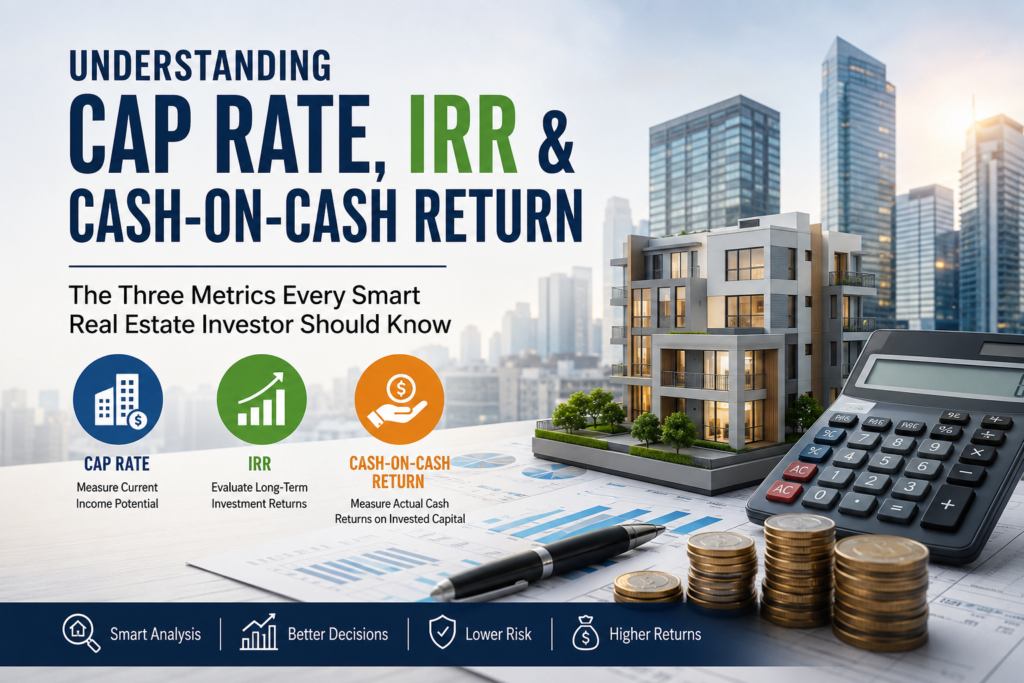
These three metrics are often discussed together. Each serves a different purpose. Cap Rate measures how efficiently a property generates income based on its market value. IRR measures the profitability of an investment by considering rental income, appreciation, holding period and future sale value. Cash-on-Cash Return measures the return earned on the investors actual cash investment after financing costs. Professional investors rarely rely on one metric. Instead they combine all three to develop an understanding of a properties financial performance.
Suppose an investor is considering two commercial office spaces. The first property costs ₹1 crore. Has a Cap Rate of 8%. It is located in a business district with stable rental demand but limited appreciation potential. The second property costs ₹1.2 crore. Has a Cap Rate of only 6%. However it is situated near an announced metro corridor and upcoming commercial developments. If the investor focuses on Cap Rate the first property seems like the better choice because it generates higher current income. However after projecting growth and future appreciation over the next ten years the second property produces an IRR of 16% compared with only 11% for the first property. If the investor finances both properties using bank loans the Cash-on-Cash Return may also differ depending on the loan terms and annual cash flow.
One of the mistakes investors make is relying solely on rental yield while ignoring appreciation
potential.
Another common mistake is underestimating operating expenses such as maintenance,
insurance, vacancies and repairs. These costs can significantly reduce returns.
Many investors also assume that property values will continue rising. While appreciation has
historically contributed to wealth creation future market conditions depend on growth, infrastructure
development, interest rates and government policies.
Finally investors often overlook financing costs. A property with rental income may still produce
poor cash flow if loan repayments are excessively high. Evaluating financing, alongside investment
returns is therefore essential.
The answer to this question depends on what you want to achieve with your investment
These metrics help you figure out how money a property can make how well it will do in the long run and what kind of return you can expect. This helps you invest with confidence
At PropoNova we do more than help with property transactions. We also offer advice on real estate backed by research on the market careful review of the legal papers and analysis of the investment. Whether you are buying a home investing in property or you are a Non-Resident Indian our team helps you find opportunities that fit with your goals and give you value in the long run. Choose PropoNova for guidance advice, on investments that is based on data and a partnership that you can trust to help you make smarter decisions when it comes to real estate.
+91-9211633367
sales@proponova.com
Your email address will not be published. Required fields are marked *


Yes. NRIs can buy residential and commercial properties in India without RBI approval, except agricultural land, farmhouses, and plantation properties.
Yes. Most Indian banks offer home loans to eligible NRIs based on their income, employment, and repayment capacity.
NRIs generally need a passport, PAN card, address proof, bank statements, photographs, and income proof. A Power of Attorney is required if someone purchases the property on their behalf.
PropoNova offers expert property advisory, legal verification, documentation support, and end-to-end assistance to help NRIs invest with confidence.
